C Alias#
Info#
Full Name |
C Alias Analysis Grammar |
Class |
Context-Free |
Kind |
Static Analysis |
Origin |
Grammar Parameters#
Parameter |
Description |
|---|---|
|
Pair \((a, a_r)\) where label \(a\) represents the assignment operation and \(a_r\) is reverse to it |
|
Pair \((d, d_r)\) where label \(d\) represents pointer dereference relation and \(d_r\) is reverse to it |
Grammar Template#
Description#
C alias analysis grammar generates language for the flow-insensitive alias analysis of C programs. Introduced in “Demand-driven alias analysis for C”. The alias problem here is formulated as a context-free language (CFL) reachability problem over a graph representation of the assignments \(a\) and pointer dereference relations \(d\) in a program.
Example Grammars#
C Alias grammar with assigment_labels = \(\{(a, a_r)\}\) and dereference_labels = \(\{(d, d_r)\}\).
S -> d_r V d
V -> V1 V2 V3
V1 -> epsilon
V1 -> V2 a_r V1
V2 -> epsilon
V2 -> S
V3 -> epsilon
V3 -> a V2 V3
S -> d_r V d
V -> ((S | epsilon) a_r)* (S | epsilon) (a (S | epsilon))*
Recursive State Machine#
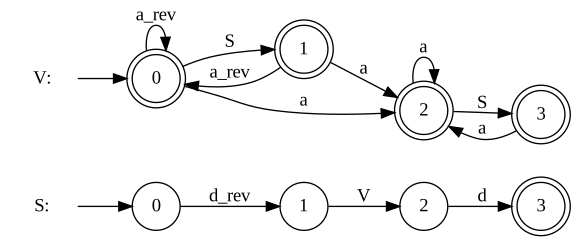
start: S
[box S]
start: 0
final: 3
0 --d_r--> 1
1 --V--> 2
2 --d--> 3
[box V]
start: 0
final: 0, 1, 2, 3
0 --a--> 2
0 --a_r--> 0
0 --S--> 1
1 --a_r--> 0
1 --a--> 2
2 --a--> 2
2 --S--> 3
3 --a--> 2